Emergency Preparedness
Required Safety Drills
In compliance with Oregon law (ORS 336.071), all FGSD schools conduct routine safety drills throughout the school year. These practice exercises help staff and students build muscle memory, maintain calm, and respond efficiently during unexpected situations:
-
Fire Evacuation Drills: Held every month that school is in session, beginning within the first 10 school days of the academic year.
-
Earthquake Preparedness Drills: Conducted at least twice per year to practice protective "Drop, Cover, and Hold On" procedures.
-
I Love U Guy’s Standard Response Protocol (SRP) Drills: Practiced a minimum of once per year for each protocol (Hold, Secure, Lockdown, Evacuate, and Shelter-in-Place), ensuring everyone knows how to secure building perimeters, internal spaces, and how to properly respond to a wide variety of emergencies.
Emergency Operations Plans (EOPs)
Every school in Forest Grove maintains an Emergency Operations Plan (EOP) designed using an all-hazards approach. These comprehensive plans outline clear strategies for a wide spectrum of potential challenges, ranging from severe weather and natural events to human-caused incidents or local utility disruptions.
-
Annual Updates & Review: EOPs are reviewed and refined each year by school principals, safety committees, and our District Safety Coordinator to incorporate current best practices and facility improvements.
-
Local Coordination: Our plans are closely aligned with local, county, and state emergency management guidelines, as well as our local first responders (including Forest Grove Fire & Rescue and local law enforcement).
-
Comprehensive Response: Each EOP establishes explicit staff roles, communication trees, evacuation and lockdown procedures, and structured family reunification protocols.
I Love You Guys: The FGSD Standard Response Protocol (SRP)
In the Forest Grove School District, establishing a safe, nurturing environment requires a proactive safety framework that everyone, students, educators, families, and emergency responders, can practice and execute with confidence. Grounded in our district maxims - Care Deeply, Stand Strong, and Adapt and Grow - we utilize the Standard Response Protocol (SRP) developed by The "I Love U Guys" Foundation.
Rather than attempting to craft separate protocols for every imaginable emergency, the SRP provides a flexible, action-based foundation designed to address a wide spectrum of campus incidents, from severe weather and medical emergencies to facility hazards or personal safety threats.
-
Research-Informed & Expert-Guided: Built through ongoing collaboration among public safety leaders, first responders, and emergency management specialists, the SRP relies on data-driven, practical strategies.
-
Streamlined Implementation: By focusing on clear, repeated actions, our schools can efficiently train staff and conduct meaningful student drills without creating unnecessary anxiety.
Uncertainty during a crisis is best countered by clear, standardized communication. The power of the SRP lies in establishing a common language shared across our classrooms, homes, and emergency response teams.
-
Continuity for Students: As children progress through FGSD schools, they encounter the exact same expectations and safety procedures year after year.
-
Predictability for First Responders: Using standardized terms ensures seamless communication between school administrators and local agencies (such as Forest Grove Police Department, Cornelius Police, and Forest Grove Fire & Rescue) from the moment an incident begins.
-
Empowerment for Families: A unified vocabulary allows parents and guardians to easily understand school updates via ParentSquare and support safety protocols at home.
How Families Can Partner With Us
Families are essential partners in maintaining a safe, calm, and coordinated response during any emergency. Here is how you can support our schools:
-
Stay Connected via Official Channels: During an emergency or weather event, FGSD broadcasts verified updates directly through ParentSquare, district email, phone alerts, and our official district website.
-
Maintain Updated Contact Information: Please ensure your home address, phone numbers, and authorized emergency contacts are always current with your student's school office or via ParentVue.
-
Rely on Verified Information: In fast-moving situations, unverified social media posts can generate confusion and delay official response efforts. Please wait for direct communications from the district before sharing rumors or forwarding unconfirmed reports.
-
Understand Reunification Protocols: If a situation requires a formal student release, follow designated reunification instructions provided via ParentSquare. Remember to bring a valid photo ID and follow staff directions on site to ensure every child is safely reunited with their parent or approved guardian.
- Create a Family Emergency Plan: Emergencies are stressful, and in an emergency situation our thoughts naturally and immediately turn to our family and loved ones. Creating, sharing, and practicing a Family emergency plan is an important step in partnering with us. Continue reading for information about and resources for creating a family emergency plan.
Earthquake Preparedness
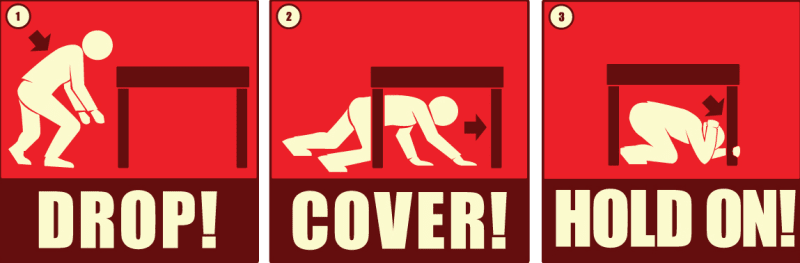
Staying low protects you from falling and allows you to move safely if you need shelter. (If you use a wheelchair or walker, lock your wheels and stay seated.)
-
- With shelter nearby: Crawl under a sturdy desk or table.
- Without shelter: Crawl next to an inside wall, away from windows. Bend over on your knees to protect your vital organs.
HOLD ON until all shaking stops.
-
Under shelter: Hold on to your shelter with one hand, and be ready to move if it shifts.
-
Without shelter: Use both arms and hands to hold onto and protect your head and neck.
Student and Parent/Guardian Reunification
Following an emergency or natural disaster, the Forest Grove School District’s primary focus is ensuring every student remains safe, accounted for, and connected with their family. Depending on local infrastructure and facility conditions, post-emergency dismissals are managed using the following guidelines:
- Minor Impact & Safe Roads: If building infrastructure is secure and district roadways are safe for travel, regular school bus routes and transportation services will run on their standard schedules.
- Severe Damage or Unsafe Conditions: If severe structural damage or road hazards prevent bus travel, bus service will be suspended. In these cases, families will be asked to retrieve their children directly from the school site.
To maintain strict accountability and student safety during a crisis, FGSD uses a structured reunification protocol rather than a typical end-of-day dismissal.
-
Why it Takes Time: A controlled release is a deliberate, step-by-step process designed to verify every student's safe custody transfer from the school to an approved caregiver. Because each check-in is carefully documented, the process can take several hours. We appreciate your patience and cooperation as our staff work to protect every child.
-
Photo Identification Required: Every adult picking up a student must present a valid photo ID at the reunification station before a child will be released.
-
Authorized Emergency Contacts: Students will only be released to parents, legal guardians, or individuals designated under the student's "Additional and Emergency Contacts" in our student system. Anyone picking up a student on your behalf must be pre-authorized in our system and present valid photo identification.
Specific directions regarding pickup locations, entry points, and timing will be communicated directly to families via ParentSquare. Please monitor your phone and email for official district updates before traveling to the school.
Home Preparedness
In the Forest Grove School District, safety extends beyond our classroom doors and into the heart of our community. Guided by our district maxims - Care Deeply, Stand Strong, and Adapt and Grow - we encourage every FGSD family to take proactive steps toward emergency readiness. When our households are prepared, our entire school community becomes stronger, safer, and more resilient.
Create a Family Emergency Plan
Preparing for the unexpected starts with an open conversation at home. Take time with your family to discuss how you will handle different emergency scenarios.
-
Communication: Agree on how family members will contact one another if phone lines or internet services are disrupted.
-
Meeting Places: Choose two designated meeting locations: one right outside your home (for immediate hazards like fires) and one safe spot within your neighborhood (if you cannot return home).
- Step-by-Step Guidance: Explore resources and planning templates at Ready.gov (FEMA) to help outline your household plan.
Aim for "2-Weeks Ready"
While disaster guidance previously emphasized having 72 hours of supplies, recent major emergencies show that first responders and utility services may need days or weeks to reach every neighborhood.
-
The Goal: Oregon emergency management officials recommend that households work toward being Two-Weeks-Ready.
-
What it Means: Having enough non-perishable food, clean water, prescription medications, and essential supplies to sustain your household independently for 14 days.
-
Learn More: Check out guidance from the Oregon Department of Emergency Management (OEM) on building long-term household preparedness.
Build Emergency Kits
In addition to keeping a two-week supply at home, assemble smaller, portable kits for your vehicles, workplaces, and your children's backpacks.
What to Include in a Student Backpack Kit:
-
Small water bottle and non-perishable energy snacks.
-
Compact flashlight and extra batteries.
-
Emergency whistle and mylar thermal blanket.
-
Travel-sized hand sanitizer and wet wipes.
-
A printed family photo or comforting note to reassure your child during a stressful situation.
Take Small Steps with "Do 1 Thing"
Preparing for emergencies can feel overwhelming, but you do not have to do everything at once. Taking small, manageable steps over time makes a significant impact on your family's safety.
-
Start Small: Focus on one simple preparedness task each month—such as storing extra water bottles one month, updating emergency contact cards the next, or testing smoke alarms.
-
Get Guidance: Visit the Do 1 Thing program for a free, month-by-month framework designed to build household readiness without stress.
Partnering for Safety: By taking simple steps today to prepare at home, you help ensure that our students, staff, and neighbors stay safe and supported when it matters most.